Whisk(e)y Library / American Category Guide 03
Bourbon &
American Whiskey
Law, Grain, Oak & Label Logic.
Bourbon is a federally defined American whiskey built around corn, controlled distillation proof and first-use charred oak. This guide starts with the legal standard, then follows the mash bill, fermentation, distillation, barrel, warehouse and label before returning to the glass.
Scope Bourbon is the main route. Rye, corn, wheat, malt, Tennessee Whiskey and American Single Malt are mapped where they clarify the wider American family; the next guide takes Rye & Corn Whiskey deeper.
Explain exactly what federal law requires for Bourbon
Read mash bill, age, proof and label terms without guessing
Connect new charred oak and warehouse conditions to the glass
Guide contents
Ten focused chapters. Start with the federal identity, then trace grain, fermentation, proof, oak, maturation and label language into practical service.
The law defines Bourbon
Bourbon is defined by origin, grain, distillation proof, barrel entry, new charred oak and a strict rule against added coloring or flavoring.
The federal floor comes first
Bourbon Whisky must be produced in the United States from a fermented mash containing at least 51% corn. It is distilled at 160 proof (80% abv) or lower, entered into charred new oak barrels at 125 proof (62.5% abv) or lower, and bottled as whisky at 80 proof (40% abv) or higher.
Federal law does not set a minimum duration for Bourbon itself, but the spirit must be stored in charred new oak. The word straight changes the time requirement: Straight Bourbon must spend at least two years in that wood.
Bourbon cannot contain neutral spirits or harmless coloring, flavoring or blending materials. Water may be used for proof adjustment. This restriction applies to Bourbon whether or not the word “straight” appears.
The federal standard says oak, not “American white oak.” Quercus alba is the dominant commercial choice, but the species is industry practice rather than the legal wording.
Read the American family first
American whiskey is a legal family. Grain percentage, barrel rules and the word “straight” tell you which route you are reading.
| Federal / state term | Production anchor | What to remember |
|---|---|---|
| Bourbon Whisky | ≥51% corn; charred new oak | U.S.-produced; no coloring/flavoring/blending materials. |
| Rye / Wheat / Malt / Rye Malt Whisky | ≥51% named grain; charred new oak | Same 160/125 proof framework. “Straight” adds 2+ years and removes additives. |
| Corn Whisky | ≥80% corn | If stored, uses used or uncharred new oak rather than the Bourbon barrel rule. |
| American Single Malt Whisky | 100% malted barley; one U.S. distillery | U.S. mashed, distilled and aged; oak barrels ≤700 L; used or new oak allowed. |
| Tennessee Whiskey | State-defined corn whiskey route | Made and aged in Tennessee; maple-charcoal filtration before aging is generally required, with a statutory exception. |
At least two years in the required wood, no neutral spirits and no coloring, flavoring or blending materials. For Straight Bourbon, the additive rule was already strict; the major added condition is time.
Both spellings are permitted in U.S. federal regulations. Brand and regional tradition decide which one you see.
Rye and Corn Whiskey deserve their own deeper production and sensory treatment. Here they remain part of the map so Bourbon stays in context.
The mash bill sets the grain architecture
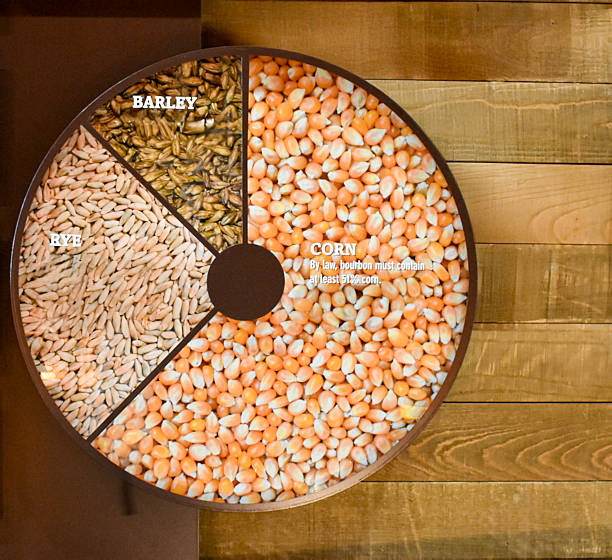
Corn is the legal majority. Rye, wheat and malted barley change the process and give the producer different raw material to ferment and distil.
Read composition before flavour shorthand
A Bourbon mash bill may sit just above the 51% corn floor or use a much higher corn share. Rye and wheat are common secondary grains; malted barley is widely used because its enzymes support starch conversion during mashing.
High-rye Bourbon and wheated Bourbon are trade descriptions, not federally defined types, and there is no federal percentage threshold for “high rye.” A known mash bill can support a style comparison; the glass still has the final word.
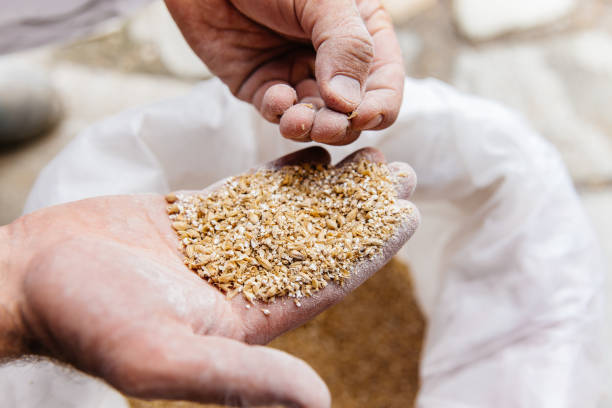
The legal anchor for Bourbon. Its starch becomes fermentable sugar during mashing; perceived sweetness in the finished whiskey should not be explained as leftover corn sugar.
Common secondary-grain choices. Rye is often associated with a firmer spicy/herbal profile and wheat with a rounder presentation, but these are tendencies rather than sensory laws.
A common enzymatic tool in American whiskey mashing. Its contribution is both technical and compositional; the percentage varies by producer.
The 51% rule is compositional, not a sweetness guarantee. Fermentation consumes fermentable sugars, while oak-derived vanilla, caramel-like aromas, alcohol strength, texture and balance can all affect how sweet the whiskey seems.
Sour mash controls the fermentation environment
American distillers commonly reuse acidic stillage from a previous distillation to condition the next mash. The purpose is process control, not a sour-tasting whiskey.
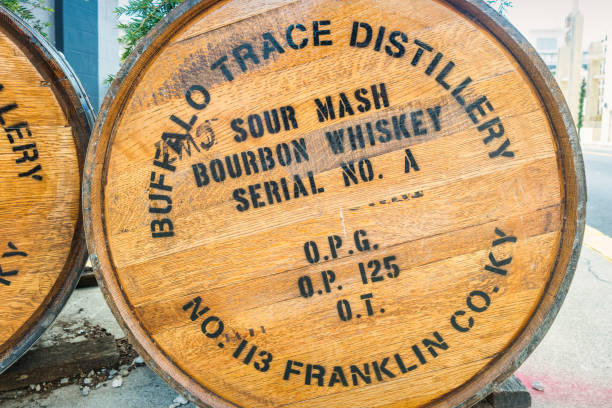
Backset links one distillation to the next
In the modern sour-mash method, a portion of acidic stillage—often called backset—from a previous distillation is added during preparation of a new mash. It helps establish a repeatable acidic environment and supports microbial control and fermentation consistency.
Yeast strain, fermentation temperature, vessel design, time and the grain composition still influence the aromatic material that goes forward to distillation. Sour mash is common practice; it is not a federal requirement for Bourbon.
Grain is milled, hydrated and heated so its starch becomes accessible for conversion.
Enzymes break the opened starch into fermentable sugars.
Backset may be added to establish the desired acidic mash environment.
Yeast converts fermentable sugars into alcohol and fermentation congeners.
Some distillers build each mash without backset and control sanitation and acidity through other means. “Sweet mash” is therefore an alternative process description, not a sweeter flavor promise.
Historic methods sometimes allowed mash to sour before yeast addition. Modern “sour mash” usually means backset use, so the same words can describe different historical practices.
Proof limits shape the distillation route
Federal ceilings matter twice: Bourbon must be distilled at 160 proof or lower and enter the new charred barrel at 125 proof or lower.
Column still does not mean neutral spirit
Large Bourbon distilleries commonly use a continuous beer still, often followed by a doubler or thumper. Other American producers use pot stills or hybrid systems. The equipment can differ; the federal proof ceiling remains the same.
The 160-proof ceiling prevents a Bourbon distillate from being taken to the neutrality required for neutral spirits. Cut points, reflux, still design and redistillation still give the producer substantial control over the spirit that enters oak.
“White dog” or “new make” is common trade language for unaged whiskey distillate. It is not the federal type designation on a finished Bourbon label.
A common Kentucky architecture: continuous first distillation followed by a second distillation stage that further concentrates and refines the spirit.
Legitimate producer choices. Still type alone does not define Bourbon; proof, grain and barrel rules do.
125 proof is a maximum, not a target. Lower entry proof means more water is present as spirit meets wood and changes the extraction environment. “Lower” or “higher” is not automatically “better.”
New charred oak defines the barrel
Bourbon’s first-fill charred-oak requirement creates an unusually direct relationship between new spirit, heat-treated wood and the final whiskey.
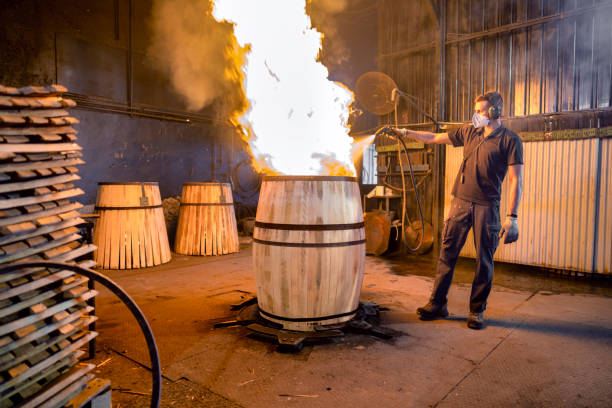
Heat changes the wood before whiskey arrives
Toasting and charring thermally transform oak. Heat breaks down wood components and opens a surface from which the spirit can extract colour and aroma-active compounds during maturation. Vanillin, oak lactones, toast, spice and caramel-like aromas are strongly associated with oak treatment and extraction.
The black char layer can also adsorb some compounds from the spirit. Deeper charring creates fissures that change access to the wood below. Distillers choose cooperage specification, stave seasoning, toast and char to suit a house style.
Each Bourbon barrel meets spirit as a first-use whiskey barrel, giving the distiller a fresh wood-extraction environment.
Toasting and charring transform wood chemistry and create a different set of extractable compounds.
The carbonized layer changes filtration/adsorption and opens cracks into heated wood below.
Water and ethanol dissolve different compounds as the whiskey repeatedly interacts with the stave.
Char numbers are cooperage and producer specifications. A heavily charred “alligator” surface is famous in Bourbon production, but federal law does not require Char #4 or any fixed number of seconds over flame.
Warehouse conditions change each barrel
Time matters, but temperature, humidity, airflow, barrel position and seasonal cycles determine what that time does.
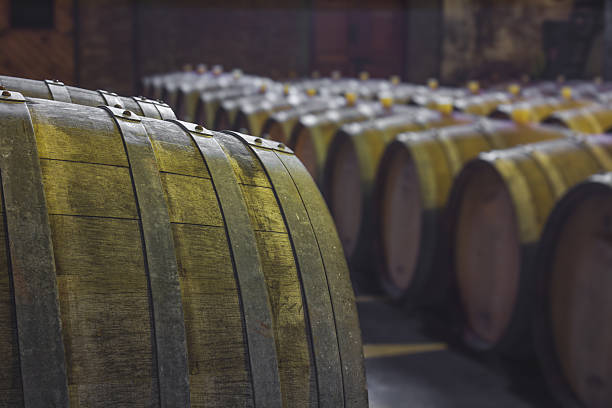
American maturation can be highly dynamic
Seasonal warming and cooling repeatedly change the relationship between spirit and wood. Warmer zones generally accelerate extraction and reaction rates; cooler zones move more slowly. Humidity also changes the relative loss of water and ethanol.
That means barrel proof can rise or fall during maturation depending on local conditions. It is inaccurate to say American whiskey always gains proof in the warehouse.
Plain Bourbon has no federal minimum age. It still must be stored in charred new oak.
Straight Bourbon requires at least two years in charred new oak and no additives.
Whisky aged less than four years requires an age statement; for a mixture without neutral spirits, the stated age reflects the youngest whisky.
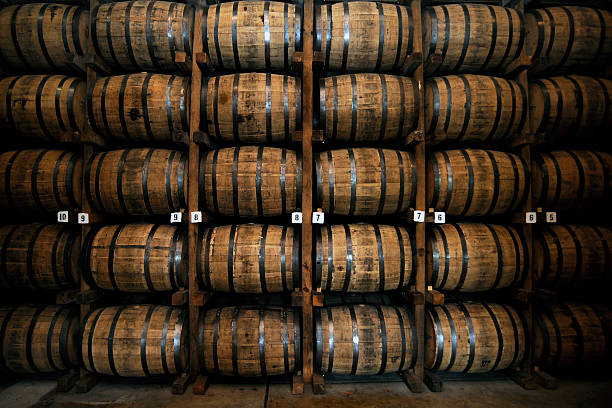
Selection happens after maturation too
Producers may bottle one barrel, marry multiple barrels, move barrels between warehouse locations, or select casks by sensory profile. These are release decisions rather than new federal Bourbon types.
Older is also not automatically better. As extraction and concentration continue, oak, tannin and dryness can become dominant. The useful question is whether time and barrel conditions produced balance.
Read the Bourbon label in order
Legal terms carry more information than marketing adjectives. Read type, geography, age and proof before the story on the back label.
Some terms are regulated tightly
Bottled in Bond means the same kind of spirit from the same distiller, same distillery and same distilling season, stored at least four years and bottled at exactly 100 proof (50% abv), with only permitted physical treatments and pure water for proof reduction.
Barrel Proof or Cask Strength may be used when bottling proof is no more than two proof degrees below the proof at which the spirit was dumped from the wood barrels. Original proof / entry proof has an even tighter meaning: bottled proof must equal the proof at which the spirit entered the barrel.
Moving Bourbon into a used Sherry, wine or other finishing cask takes it outside the plain Bourbon standard. TTB treats products such as “Bourbon Whisky Finished in Sherry Barrels” as distilled-spirits specialties with a qualifying designation.
Commonly describes a release drawn from one barrel. It is not a separate federal whiskey standard of identity, so confirm how the producer defines and bottles it.
No federal batch-size threshold defines the term. It can be meaningful producer language, but it is not a legal quality grade.
Mash-bill descriptions without a federal threshold. Useful only when tied to a disclosed recipe or reliable producer information.
Price, allocation and secondary-market hype are not legal quality categories. An unopened bottle does not continue maturing like a barrel; evaluate type, age, proof, producer and sensory quality before rarity.
Bourbon reaches beyond Kentucky
Kentucky is central to Bourbon history and scale, but federal Bourbon identity is national. Place can be stated only when the whiskey actually earns the claim.
Geography can be legal information
A place, state or region may appear as part of a U.S. whisky designation when the whisky was distilled—and any required aging took place—in that location. A label such as New York Bourbon Whisky therefore carries a real origin claim.
Kentucky’s limestone geology, cooperage network, climate, grain access and accumulated distilling infrastructure help explain its prominence. None of those factors appears as a federal Bourbon requirement.
Tennessee
A state-defined whiskey identity
Tennessee law requires Tennessee Whiskey to be manufactured and aged in Tennessee, use at least 51% corn, meet the 160/125 proof limits, use new charred oak and generally be filtered through maple charcoal before aging. The statute includes a narrow exception to the charcoal-filtration requirement.
Water chemistry can matter to a distillery, and limestone-rich water is strongly associated with Kentucky production. Federal Bourbon identity does not require limestone water or water from Kentucky.
Taste and serve from evidence
Bourbon gives strong production clues, but a tasting note should still begin with what is in the glass before explaining why.
Describe first. Explain second.
Common Bourbon vocabulary includes corn or cereal notes, vanilla, caramel or toffee, toasted oak, baking spice, nuts, dark fruit, cocoa and char. New oak is a strong production explanation for many vanilla, toast and caramel-like aromas; the exact balance still depends on spirit, barrel and time.
Compare known mash bills rather than guessing them blind. A rye-forward Bourbon may show more spice or herbal lift and a wheated Bourbon may feel rounder, but fermentation, distillation, proof and maturation can override simple grain stereotypes.
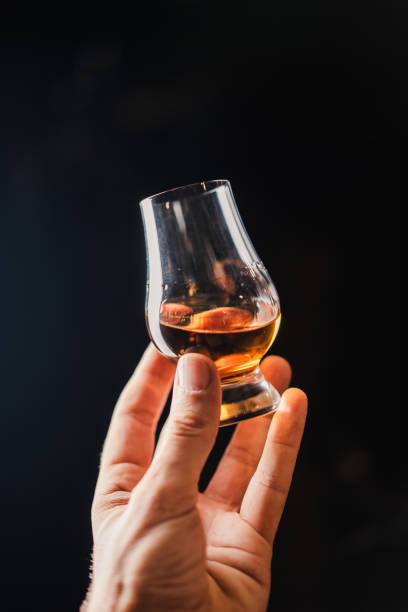
Read the glass
Move in the same order every time. Separate aroma, palate, texture and finish before connecting those observations back to production.
Serve deliberately
Choose the format around the bottle, the proof and the guest. Neat, water, cocktails and food each reveal different parts of the whiskey.
Use a tulip-shaped glass for training or detailed comparison. Give high-proof whiskey time in the glass before adding water.
Add a few drops at a time rather than following a fixed dilution formula. The useful amount depends on starting proof and the taster.
Bourbon works naturally in an Old Fashioned, Whiskey Sour, Mint Julep and Boulevardier. Rye often gives a drier, more spice-led alternative in whiskey classics.
Smoked meat, roasted nuts, aged cheese and dark chocolate can echo oak, toast and savoury-sweet notes. Pair by the actual bottle, not the category name alone.
Protect the bottle
Once whiskey is bottled, storage is about preserving the spirit rather than continuing maturation.
Store bottles upright, away from strong heat and direct light. Whiskey does not continue barrel maturation after bottling.
Oxidation changes become more noticeable as headspace grows. For valuable training bottles, minimize heat/light exposure and avoid leaving very low fills for long periods.
Core principle
Law fixes the floor.
Producer choices build the whiskey.
Bourbon becomes easier to read when you separate what is mandatory from what is optional. Corn, proof ceilings and new charred oak create the legal frame. Mash bill, yeast, still design, entry proof, cooperage, warehouse, selection and bottling decisions create the release in your glass.
REFSources & Further Reading
Primary legal and technical references behind this Bourbon & American Whiskey guide. Federal standards were checked against current sources on 21 August 2026.
Federal law & labels
27 CFR § 5.143 · WhiskyFederal standards of identity · Bourbon, Rye, Corn, Straight, Blended and American Single Malt 27 CFR § 5.74 · Age statementsFederal age, storage and youngest-whisky rules 27 CFR § 5.87 · Barrel ProofFederal meaning of barrel proof, cask strength and entry proof 27 CFR § 5.88 · Bottled in BondSame distiller, distillery, season; 4+ years; 100 proof TTB · Distilled Spirits FAQsOfficial guidance · whisky age statements TTB · Formulas and LabelsOfficial examples · plain Bourbon vs finished specialty productsAmerican category law
TTB · American Single Malt WhiskyFinal standard effective 19 January 2025 Tennessee General Assembly · HB1084State Tennessee Whiskey requirements and maple-charcoal rule 27 CFR § 5.63 · Mandatory label informationType, alcohol content, state of distillation and other required information 27 CFR § 5.1 · DefinitionsFederal meaning of age for Bourbon and other whiskiesProduction & oak
Buffalo Trace · Distillery ProcessProducer example · grain, fermentation, distillation and new charred oak Maker’s Mark · Bourbon Making ProcessProducer example · wheated mash, limestone water and sour mash Buffalo Trace · Experimental CollectionProducer experiments · entry proof, oak species and barrel variables UC Davis · Oak LactonesWood chemistry · oak-derived aroma compoundsSensory & service
Sources of Volatile Aromatic Congeners in WhiskeyResearch · aroma formation across fermentation, distillation and maturation Impact of Dilution on Whisky AromaResearch · volatile and sensory effects of water addition IBA · Old FashionedOfficial cocktail reference IBA · Whiskey SourOfficial cocktail referenceContinue learning