Vodka & Neutral Spirits Library / Guide 02
Neutral Spirit& Rectification
Separation, Reflux & Output Specification.
This guide begins inside the rectification system. It follows a fermented feed through stripping, repeated vapour–liquid contact, reflux, draw management and final neutral-spirit specification.
Scope Raw-material preparation and fermentation are covered in Vodka Fundamentals and later dedicated guides. Here, the focus is the separation system itself.
Start with the output target →Continue where you left off →
Separate stripping from rectification and follow the column in the correct direction
Explain what trays, packing, reflux and draw points actually do
Read neutral spirit as an output specification, not simply a high ABV number
Guide contents
Eight focused chapters. Fundamentals gave you the category map; this guide goes deeper into the rectification system without repeating the overview.
Define the output before reading the equipment
“Neutral spirit” is a regulated production target. The number changes with the jurisdiction, so attach the threshold to the rule that sets it.
Ethyl alcohol of agricultural origin
The current EU definition requires alcoholic fermentation followed by distillation of agricultural products, a minimum strength of 96.0% ABV and specified maximum residue levels.
Neutral spirits or alcohol
Under 27 CFR § 5.142, neutral spirits are distilled from suitable material at or above 95% ABV. If bottled as neutral spirits, they are bottled at not less than 40% ABV.
96.0% in the EU and 95% in the US are legal anchors. Do not present either number as a universal definition of “purity.”
The column has two jobs
Stripping recovers alcohol from the fermented feed. Rectification increases concentration and sharpens separation.
Follow function before hardware
A continuous distillation column can contain a stripping section below the feed point and a rectifying section above it. Heat drives vapour upward while liquid moves downward through the system.
The lower section removes alcohol from the descending liquid. The upper section repeatedly enriches the rising vapour in the more volatile components. A condenser at the top creates the liquid needed for reflux and product collection.
The column receives an alcoholic feed whose exact composition depends on the upstream process.
Heat and rising vapour remove alcohol from liquid moving toward the bottom.
Repeated contact progressively changes the composition of vapour and liquid.
Overhead vapour is cooled so it can be divided between reflux and product.
Part returns to the column; the remainder leaves as distillate.
These jobs do not have to live inside one tower. A plant may separate stripping and rectification between different columns. Read what each section does before counting vessels.
Quick check
Which part of the system enriches the rising vapour after the feed enters?
Name the function, not the brand or still model.
The rectifying section. The stripping section recovers alcohol from the descending liquid; the rectifying section increases concentration through repeated vapour–liquid contact.
Contact creates separation
A tall column works because vapour and liquid meet repeatedly—not because ethanol simply boils while water stays behind.
Each stage changes both phases
Distillation separates according to differences in volatility and vapour–liquid equilibrium. Rising vapour becomes richer in more volatile components while descending liquid becomes richer in less volatile components.
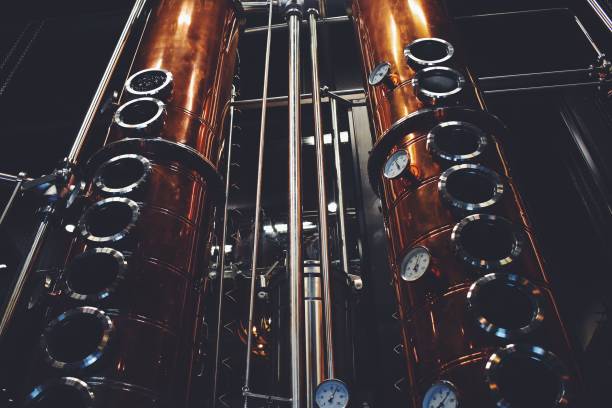
Trays or packing create the contact area needed for that exchange. More effective separation stages allow the system to approach the required composition more closely.
Discrete contacting levels hold liquid while vapour passes through it.
Structured or random surfaces create continuous contact between vapour and liquid.
Physical height or tray count alone does not equal separation performance; efficiency matters.
Distillation does not simply “boil off the alcohol.” Ethanol and water are present in both vapour and liquid. Repeated equilibrium contact is what progressively separates them.
Reflux sharpens rectification
Part of the condensed overhead liquid is returned to the column so the rectifying section can keep separating.
Return liquid to create more contact
At the top of the column, concentrated vapour is condensed. One portion leaves as product; another portion returns downward as reflux.
That returning liquid meets rising vapour again. Increasing reflux generally increases separation, but it also demands more energy and reduces the amount of product taken off for a given vapour flow.
Condensed liquid is sent back into the rectifying section.
Descending reflux meets rising vapour across more effective stages.
Sharper separation generally requires more internal circulation and energy.
When a producer discusses “purity,” ask how the column is operated—not only how tall it is.
Quick check
What is reflux?
Keep the answer operational.
Reflux is part of the condensed overhead liquid returned to the column. It supplies descending liquid for further vapour–liquid contact and improves separation in the rectifying section.
Draw points manage the streams
A continuous system can collect, remove or recycle streams at different points according to the design and the compounds being managed.
Continuous separation is not a giant batch cut
Compounds distribute through a column according to volatility, concentration and operating conditions. Producers can use overhead, side or dedicated-column streams to manage what leaves the system and what is recycled.
Do not force the pot-still language of heads, hearts and tails directly onto every continuous rectification system. The engineering question is where each stream is taken, what it contains and what happens to it next.
Keep a stream that meets the intended product specification.
Return a stream to another point in the system for further separation.
Take an unwanted or off-spec stream out of the product path.
Describe the stream and its function before attaching a familiar batch-distillation label to it.
Configuration changes the route
There is no single universal “vodka column.” Distilleries arrange the same separation jobs in different equipment configurations.
One main tower can place the stripping section below the feed and the rectifying section above it, with a condenser and reflux system at the top.
The first column can recover alcohol from the fermented feed while a second column receives that alcohol-rich stream and increases concentration.
Larger systems may add columns or dedicated sections to manage selected volatile streams, improve recovery or meet a tighter product specification.
Column names vary between manufacturers and plants. Function is the stable vocabulary: strip, rectify, condense, reflux, draw, recycle and collect.
Specification is more than ABV
High alcoholic strength tells you concentration. It does not, by itself, tell you whether every compositional requirement has been met.
Use the current EU agricultural-alcohol specification as an example
Article 5 of Regulation (EU) 2019/787 sets a minimum strength of 96.0% ABV and maximum residue levels for ethyl alcohol of agricultural origin. The limits below are expressed per hectolitre of 100% vol. alcohol.
A sample can reach 96.0% ABV and still fail the EU definition if a listed residue exceeds its permitted maximum. Strength is one measurement inside a wider specification.
Read the system from evidence
When a producer talks about rectification, translate the claim into functions, controls and measurable output.
Name the jurisdiction and the required spirit specification first.
Follow the feed through the actual sections or columns.
Identify trays or packing and the role of effective stages.
Separate product take-off from liquid returned for further contact.
Ask what is collected, recycled or removed and why.
Use ABV together with the analytical limits that apply to the output.
Laboratory numbers and sensory assessment answer different quality questions.
Filtration, water, flavouring or category-specific rules belong to the next production decision.
Explain rectification in one sentence: the system repeatedly separates vapour and liquid until the producer reaches the required neutral-spirit composition, then verifies the output against the relevant specification.
Read the system
Follow function
- Feed point before column name
- Stripping before rectification
- Contact through trays or packing
- Reflux as internal recirculation
- Draw points by stream function
Read the output
Follow evidence
- Jurisdiction before threshold
- ABV plus composition
- Analytical limits where required
- Sensory check as a separate layer
- Later processing kept separate
REFSources & Further Reading
Primary legal and technical references used for this focused rectification guide.
European Union
Regulation (EU) 2019/787 · consolidated textPrimary law · Article 5 agricultural alcohol strength and residue specificationContinue the sequence
Guide 03 · Grain Vodka
Follow cereal raw materials from starch and mash design to fermentation and the clues they leave before rectification.